
Planara Conduit · Marine
Conduit for marine OEMs and their dealer networks.
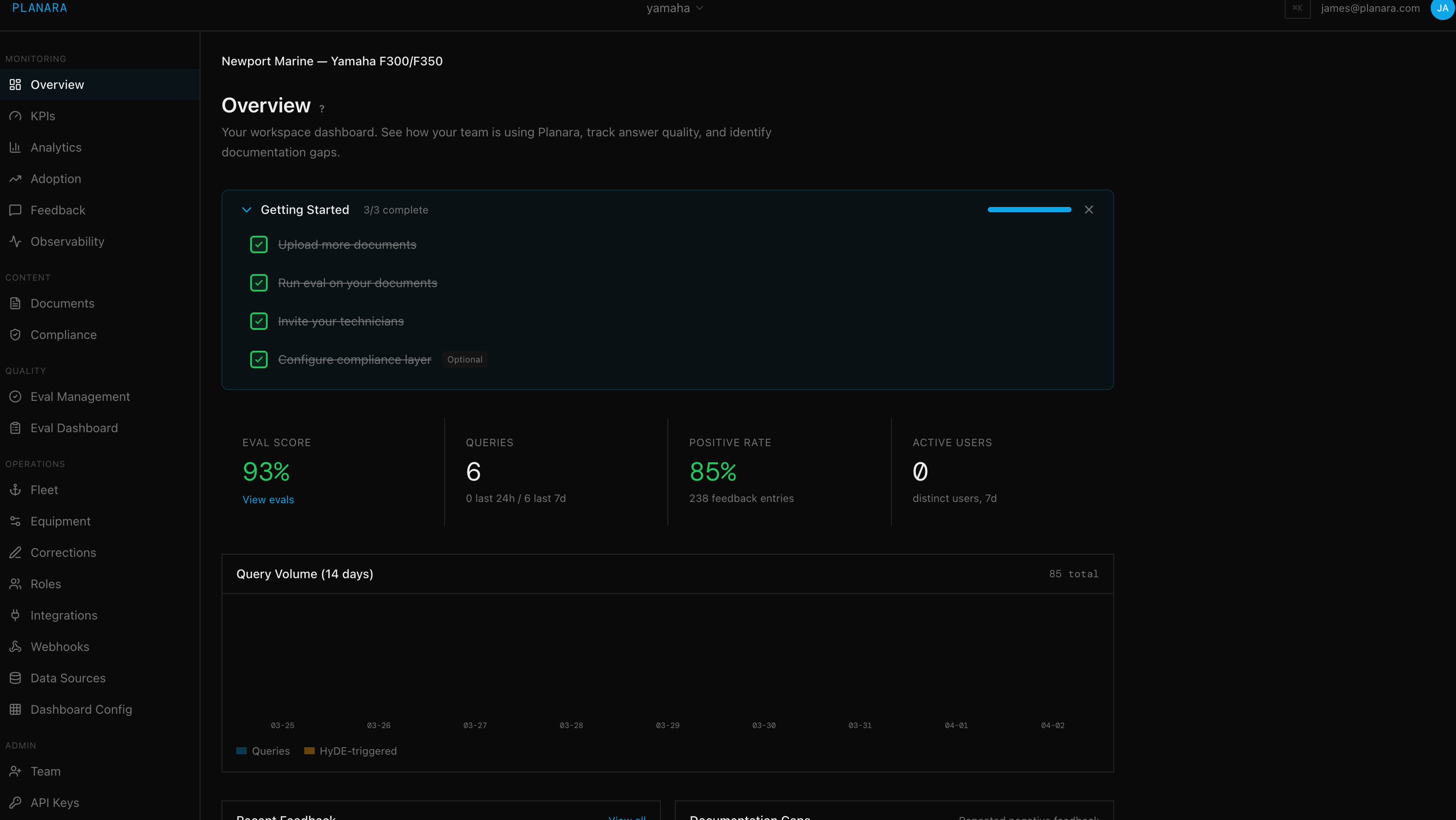
The reference deployment is built on the Yamaha F300 corpus — owner's manual, service manual, ABYC and ANSI Z535 standards, and the technical service bulletins that update them.
The same Conduit serves the technician at the bench, the owner at the dock, and the dealer service writer between them — each with the surface that fits how they actually work.
What oil does the F300 require?
Specifications
Run engine to operating temperature before draining. Hot oil flows more completely. Use caution — surfaces will be hot.
Why marine
Why marine fits Conduit's model.
Marine is the right place to prove out the Conduit pattern before it generalizes to other equipment categories.
The standards layer.
Marine has a real standards stack: ABYC for vessel construction and electrical, EPA and Coast Guard for emissions and safety, ANSI Z535 for the warning labels that have to render verbatim in any answer the platform produces. Conduit is built to respect those — every spec, every warning, traces back to the page that authorized it.
The documentation density.
Marine engines are mechanically rich, well-documented, and dealer-network distributed. The reference deployment is the Yamaha F300, but the same deployment pattern extends to outboard, sterndrive, diesel propulsion, and marine generators. Where the OEM has a manual, Conduit has a corpus.
The service workflow.
Seasonal demand, hours-based service intervals, telemetry available through Smart Craft and Siren Marine, and customers who care deeply about their vessels but rarely read the manual. The work is predictable enough to plan against and complex enough that a confident, cited answer changes the day.
What it looks like
What a marine Conduit deployment looks like.
The reference deployment is built on the actual Yamaha F300 corpus. Real procedures, real warnings, real citations. The same shape extends to any marine OEM that ships documentation alongside the equipment.
Ingested corpus
- Owner's manualF300 OM · LIT-18626-12-51 · ~280 pages
- Service manualF300 SM · procedures, torque tables, diagnostics
- Technical bulletins12 active TSBs covering ECU, trim, fuel, recall scope
- Total ingested~1,200 pages, indexed and citation-tracked
Sample answerable procedures
- Oil change interval and YAMALUBE specification
- Anode inspection and replacement (do-not-paint guidance)
- Thermostat operating range and replacement procedure
- Idle hunting at warm start — diagnostic ladder
- Trim sensor calibration after sensor replacement
- Smart Craft pairing failure recovery
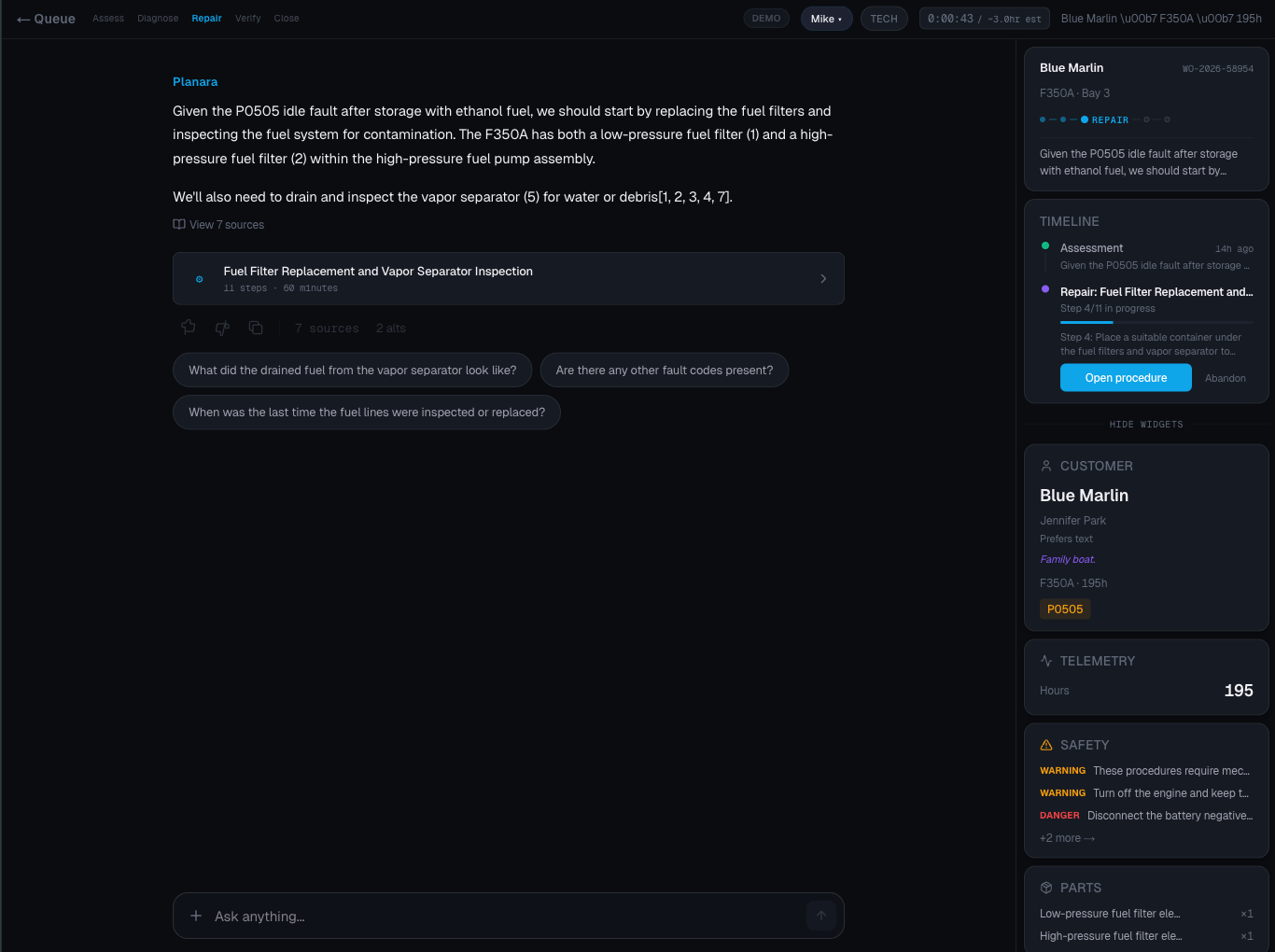
The doing side
Cited procedures, not paragraphs.
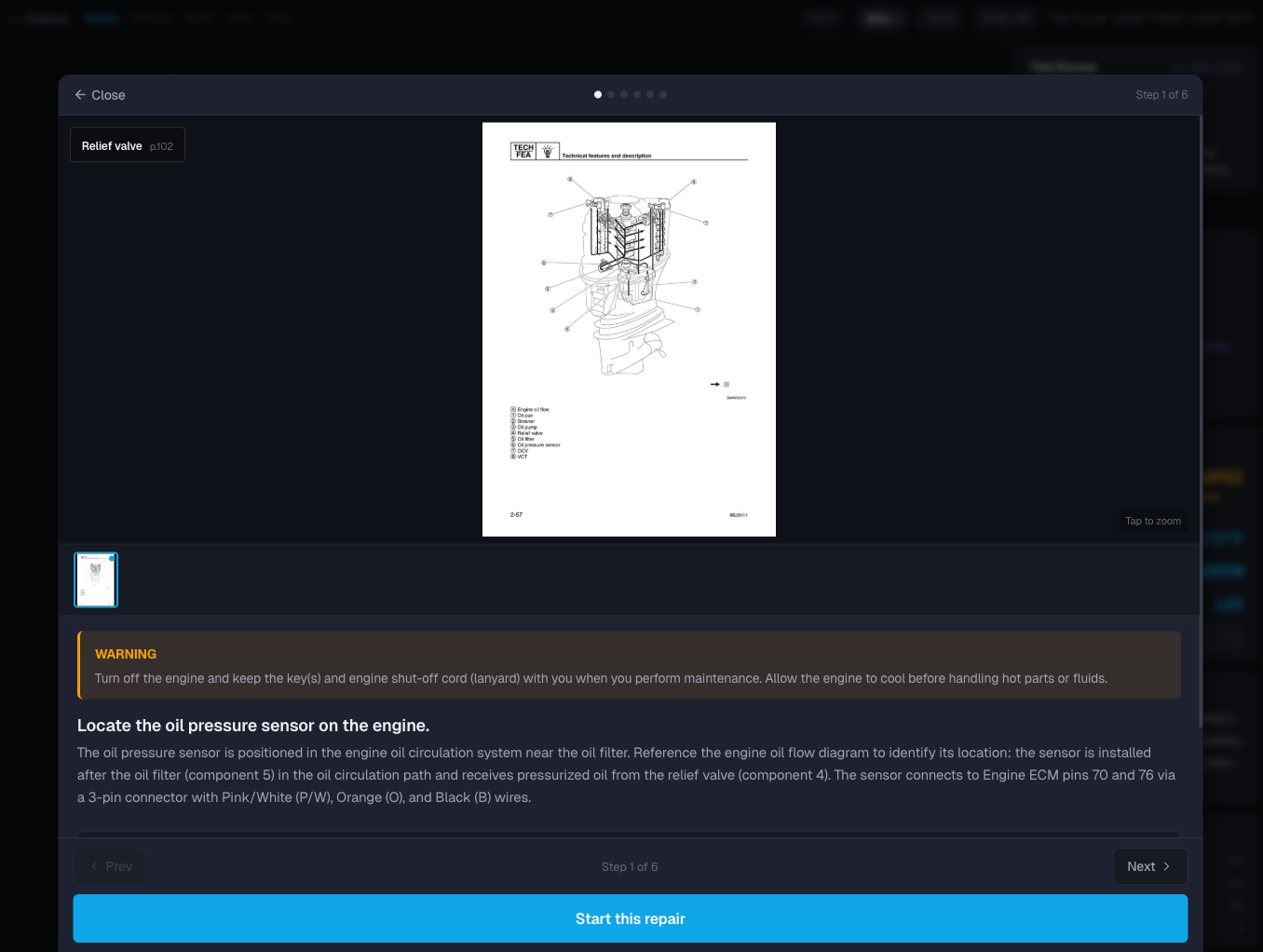
When the tech is in the repair, the answer is a step-by-step procedure with the source page image attached. Every safety warning stays verbatim. Every step traces to the page that authorized it.
Example
What network analytics actually surface.
Illustrative — not a recorded statistic
Example: a thermostat replacement might resolve overheating in most cases, but in some cases the actual root cause is the tell-tale water passage. Conduit's network analytics surface that distinction.
Where we are
Where we are.
Currently in active conversations with marine OEMs about deeper reference deployments. We're not going to name names — if you're a marine OEM or dealer network and want to talk specifics, the door is open.
Working prototype on your corpus in 1–2 weeks. Pilot in 4–8.