
Planara Conduit · The platform
How Planara Conduit works.
Conduit ingests manufacturer manuals, industry standards, and service bulletins, and returns cited, safety-validated answers to the people who service the equipment.
Technical Service Intelligence
Manuals, standards, bulletins. One output. No invention.
Technical Service Intelligence (TSI) is the layer between authoritative documentation and the person holding the wrench. Conduit is the implementation. Every claim it makes is traceable to a page in the source library — nothing is generated from outside it.
Manuals
Owner's manuals, service manuals, parts catalogs — every page indexed, every diagram preserved.
Standards
ABYC, ANSI Z535, OSHA, ASHRAE, ASE, EPA — referenced inline so safety language survives the answer.
Service bulletins
Technical service bulletins and field updates layered over the base library so the latest guidance wins.
Output
Cited, safety-validated answers
Structured responses with tappable citations to the original page. Safety language preserved verbatim. Confidence scored per answer. When the library doesn't have it, Conduit says so.
The architecture
Documentation in. Role-specific surfaces out. A feedback loop in between.
One ingestion pipeline. Three role-specific surfaces. Every field correction flows back into the index so the next technician gets a better answer than the last one got.
What each role gets
One platform. Four roles. Two contexts.
Conduit isn't a chat window bolted on the side of a service business. It's a query layer the whole organization works against — each role through the surface that fits how they work.
Role 01
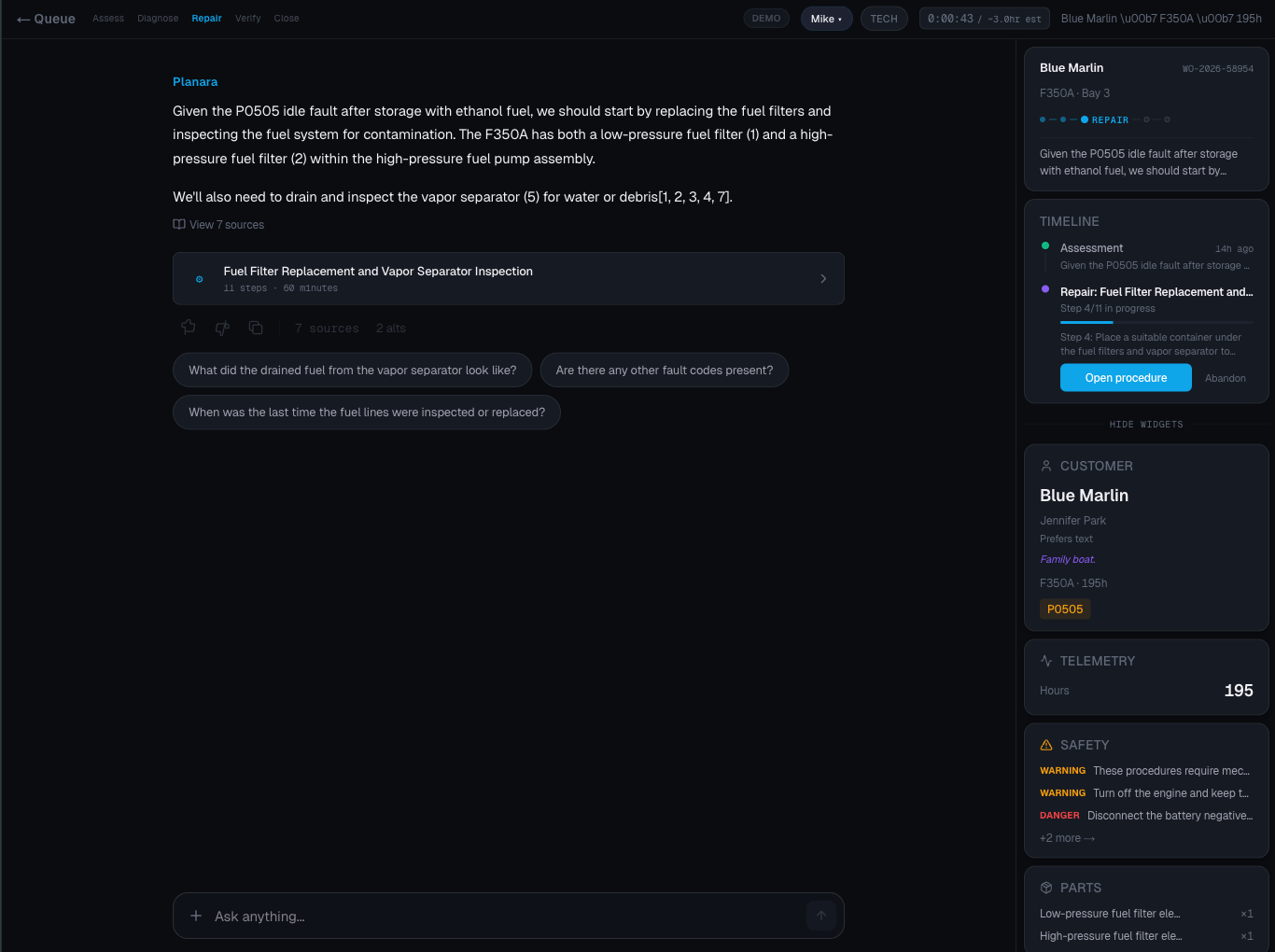
Field technician
The person at the bench, with the engine open, holding a torque wrench. They get specs, parts, and procedures pulled directly from the manual — never invented. Citations are tappable to the source page so the tech can verify before turning a fastener.
Outcome
Time on tool goes up because time hunting through PDFs goes down.
Role 02
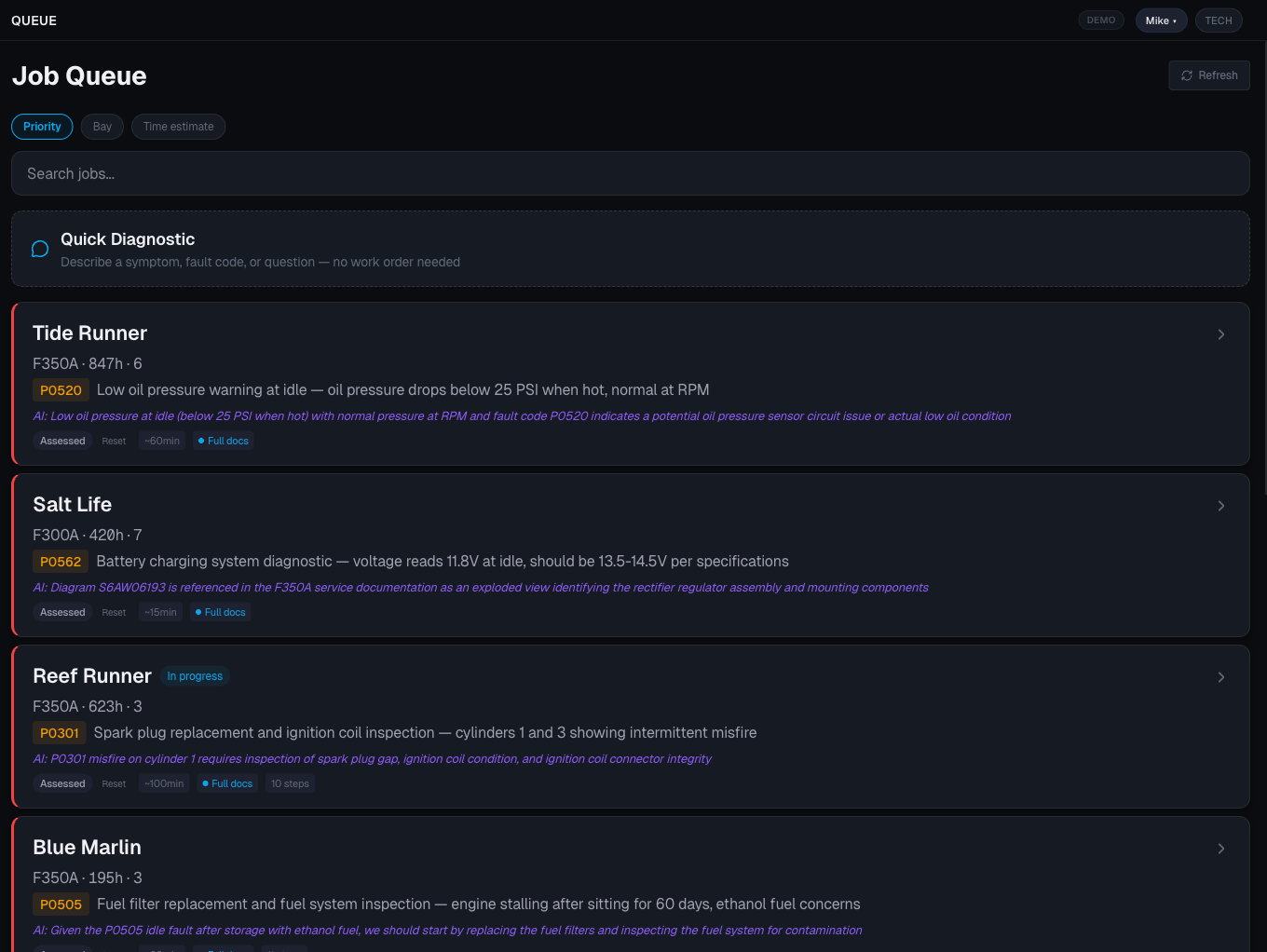
Service writer / dealer service desk
The person taking the customer call and translating it into a work order. They get a plain-language interpreter that turns owner symptoms into the right diagnostic procedure, the right parts list, and the right service interval — backed by the same documentation the technician will use.
Outcome
Work orders get scoped correctly the first time, before the boat hits the lift.
Role 03
Service leader / operations leader
The person responsible for throughput, warranty exposure, and tech retention — whether that's a dealer principal looking across the bay floor or a manufacturing ops director looking across the line. They see which jobs are taking longest, which questions are stalling the floor, and where the documentation is failing the team. Same role, two contexts: dealer service network and internal manufacturing operations.
Outcome
The signal to fix a process — or escalate a documentation gap to the OEM — arrives in days, not quarters.
This week
847 queries · 31 techs active
Queries today
847
+12%
Active techs
31
+3
Citations served
2,104
+18%
Avg confidence
0.86
verified
Query volume · 14 days
+12% wk/wk
Role 04
OEM product team
The team that wrote the manual in the first place. They see what the field is actually asking — by model, by region, by service interval — and which questions Conduit can't answer because the underlying documentation doesn't cover them. The unanswered queries are the next service bulletin.
Outcome
Documentation evolves from a static asset to a feedback-driven product, with measured impact downstream.
Top unanswered questions
The correction pipeline
The library learns from the floor it serves.
Every correction a technician submits is reviewed and validated inside the same tenant — and improves the next answer for the next technician on the same team. Corrections stay scoped to the dealership that submitted them. Nothing leaves your tenant.
Step 01 · Flag
A technician flags the answer.
Mid-job, a tech sees Conduit return a torque spec that disagrees with the latest service bulletin. They tap the citation, hit "flag this answer," and write one line: "TSB 2024-07 supersedes the OM value here." The job continues. The flag posts to the dealer's validation queue.
Step 02 · Validate
The dealer service leader validates it.
The flagged answer lands in a queue inside the same dealership's console — alongside the original question, the cited source, the tech's note, and the suggested fix. A senior tech or service leader reviews the bulletin reference, confirms the supersession, and approves the correction.
Step 03 · Apply
The next technician gets the corrected answer.
On approval, the correction is layered into the dealer's tenant index. The next time anyone in the dealership asks the same question — or any question that surfaces the same procedure — the corrected answer appears, with the original citation plus the validated correction noted inline.
Single-tenant loop, by design. Corrections improve the dealership that made them. They don't flow to other tenants, and they don't train any shared model. When the OEM wants the signal, it sees the aggregate pattern of unanswered questions in its own console — never another dealer's data.
Standards integration
The standards live inside the answers, not in a separate binder.
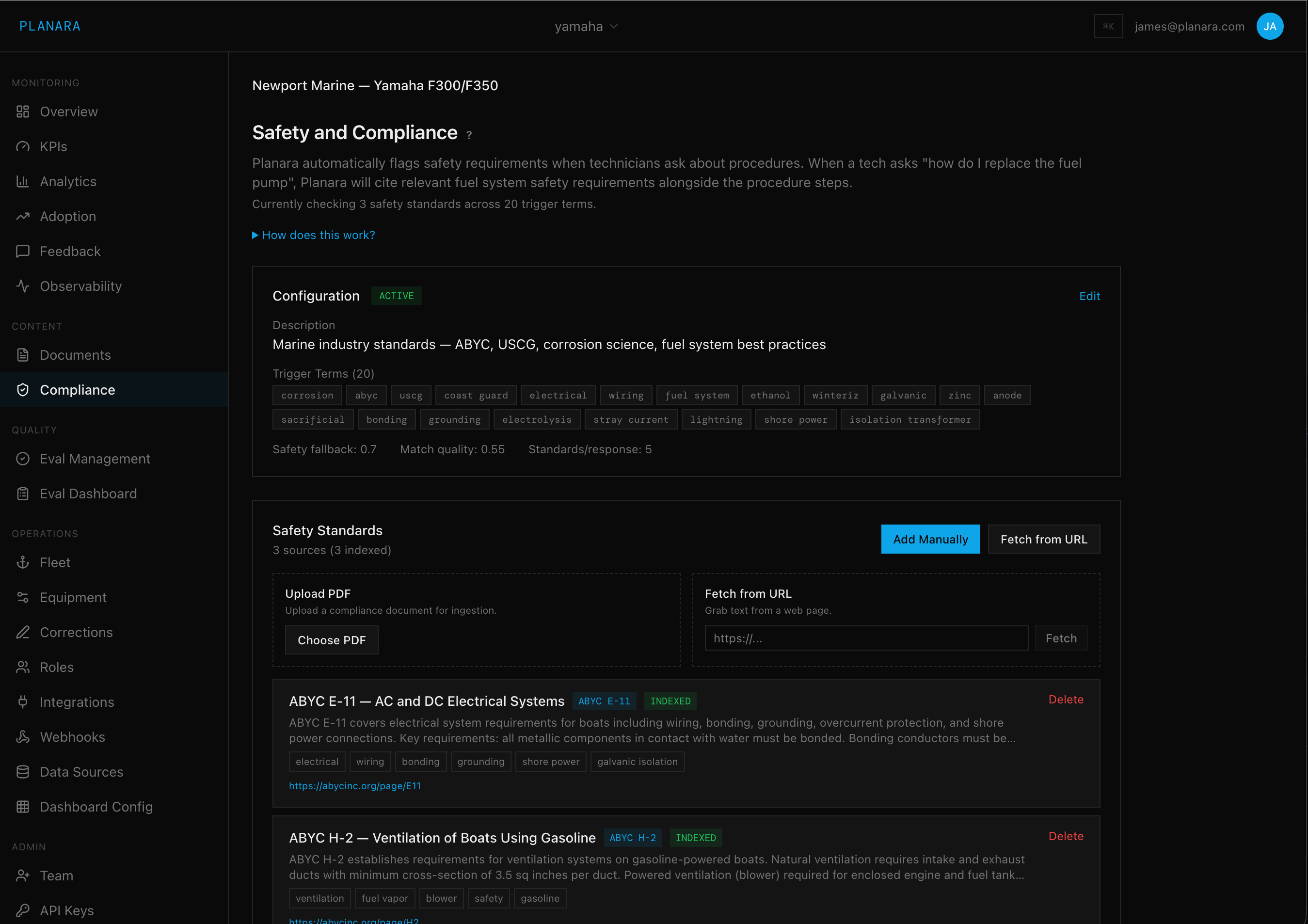
Conduit indexes the relevant industry standards alongside the OEM documentation so the safety language a technician needs is part of the answer — not a separate lookup.
ABYC for marine wiring and fuel; ANSI Z535 for safety signs and labels; OSHA 1910 for general industry; ASHRAE and EPA 608 for HVAC and refrigerant handling; ASE for technician credentials. Standards are tagged by vertical so the right set surfaces inline.
Under the hood
For the technical buyer.
The four properties that make Conduit safe to put in front of a regulated workforce.
Multi-parser ingestion
Each document is parsed by a primary extractor and validated by a second, independent parser. Diagrams, tables, and torque specs survive intact — and disagreements between parsers are flagged for review, not silently flattened.
Page-level citations
Every claim resolves to a specific page in a specific document. Citations are tappable and surface the original page image, so the technician verifies the source before turning a fastener.
Namespace isolation
Each tenant's documentation lives in its own logical namespace. No tenant's data, queries, or corrections cross into another tenant's index. Enforced at the storage layer, not at the application layer.
Confidence scoring
Every answer carries a confidence tier (verified / informed / uncertain). When the library doesn't support a strong answer, Conduit says so explicitly rather than smoothing the gap with prose.
Deployment paths
Pick the surface. Conduit is the layer underneath.
Reference apps
Pre-built surfaces, your library.
Use the Planara reference apps for technician, owner, and OEM workflows. Branded for your dealer network. Fastest path to a working pilot.
Widget API
Embed Conduit into what you already run.
Drop the query interface into your existing dealer portal, service writer console, or technician tablet app. Same answers, your chrome.
Custom build
Conduit as the query layer underneath.
Build your own surface against the Conduit API. You control the UI; Conduit handles ingestion, retrieval, citation, and safety validation.
Common questions
What technical buyers ask first.
How long does a Conduit deployment take?
A working prototype on 2–3 of your manuals takes 1–2 weeks. A pilot deployment with the full library, role-specific surfaces, and real users takes 4–8 weeks. The slow part isn't the technology — it's working through the documentation library with your product team and confirming what the answers should look like.
What happens when a manual updates?
New revisions and service bulletins are re-ingested and the index is updated in place. Where a bulletin supersedes a base manual value, Conduit prefers the bulletin and flags the supersession in the citation. Old document versions are retained so any historical answer can be traced back to the source it was generated from.
How is namespace isolation enforced?
Each tenant has its own logical namespace at the storage layer. Queries, retrievals, corrections, and analytics are scoped to that namespace before any application code runs. There is no shared index across tenants, no cross-tenant training, and no shared model fine-tuned on customer data. A dealer's corrections improve their own deployment — not anyone else's.